
Tech Environmental e-Newsletter
Maine DEP Updates
In July 2008, our newsletter reported that the use of the n-butanol odor scale, a qualitative method of determining odor impacts, was becoming common across the Northeast. We're pleased to report that this trend has continued. The Maine Department of Environmental Protection (MEDEP) recently proposed to make qualitative odor standards an official part of its approach to regulating solid waste and septage management facilities. The proposed evolution in MEDEP's response to odor incidents, outlined in this Powerpoint presentation, would use an odor intensity referencing scale (OIRS) that allows objective evaluations of the intensity of odor in ambient air based on personal observations. MEDEP's commendable proposal would allow regulators to respond to and control odors by evaluating them both qualitatively and quantitatively. While Maine has retained Tech Environmental to train its odor responders in the use of scientific tools to measure odorants, there is no mechanical instrument that can effectively match the capabilities of the human nose. OIRS-based approaches to odor complaint response will help MEDEP evaluate odor impacts well below the threshold of most scientific instruments in use today, while controlling for individual variations in odor sensitivity among responders. This will allow the agency to apply a much more sophisticated regulatory approach to odorous facilities than simply demanding the unachievable: "No odors."
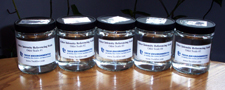
The "Report on Odor and Gas Management at Solid Waste Facilities," prepared by Paula Clark of MEDEP's Division of Solid Waste Management, describes the agency's use of qualitative standards that were developed in consultation with Tech Environmental. MEDEP uses a modified five-level n-Butanol scale, whereby an odor responder compares an odor's intensity to a series of jars, each containing a control level of a standard odorant. This approach allows MEDEP to establish odor intensity in an objective fashion: the proposed regulations would prohibit intensity of odor impacts above a 4 on the five-point scale for any period of time, above a 3 for fifteen minutes or more, or above a 2 for sixty minutes or more. While odor measurement instruments are growing more sophisticated every year, there is still no substitute for the power of our noses. By using OIRS methods, we can filter out the differences in human sensitivity to odors and turn noses into the most valuable odor instrument of all. MEDEP is on the right track when it comes to managing and responding to odors, and no doubt we will see more regulatory agencies following suit in the near future. For more information regarding OIRS, odor training and odor science, contact Michael Lannan by email at mlannan@techenv.com. |
Tech Trains Regulators in Allegheny County, PA Tech recently trained Allegheny County Health Department (ACHD) officials. Tech's training team drew upon its experience training hundreds of odor responders (including MEDEP, at left) to prepare ACHD staff for challenges they will face in the field. The first day of the seminar focused on an in-depth exploration of the science of odor. Tech detailed methods for quantifying odor and instructed ACHD staff on proper odor response procedures. On the second day of the program, participants traveled to the 225 MGD Allegheny County Sanitary District (ALCOSAN) wastewater plant, where they could enhance their newfound knowledge of odors by experiencing them in a real-world situation. ALCOSAN recently implemented extensive odor control upgrades, but odor was still present within structures. ACHD staff were able to use qualitative and quantitative techniques to measure and evaluate odor levels. Tech's odor training courses often offer CEO credits to participants. For more information on Tech Environmental's odor training services, contact Matthew Riegert at mriegert@techenv.com. |
STAFF SPOTLIGHT
Mr. Riegert often screens facility
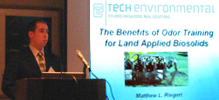
Mr. Riegert presenting a paper on odor training at the NEWEA Conference in Boston Mr. Riegert is an environmental engineer who has played a critical role in numerous Tech Environmental projects. His expertise extends to air quality, odor and noise sampling, acoustic and air quality dispersion modeling, preparation of various permit applications, and design of odor control systems. You can contact Matthew Riegert by email at mriegert@techenv.com or by telephone at
CONTACT US 303 Wyman Street, Suite 295 Waltham, Massachusetts 02451 ph. 781-890-2220 fax 781-890-9451 email info@techenv.com
SUBSCRIBE TO THIS NEWSLETTER If you have been forwarded this email and wish to receive it regularly, click here to subscribe. |


| TECH ENVIRONMENTAL, INC. specializes in finding real solutions to air quality, odor control, noise and vibration, fugitive dust, and health & safety challenges. Our focused knowledge in air-quality-related fields is enhanced by a comprehensive understanding of environmental regulations and technologies. Visit our website at www.techenv.com or contact us by phone at (781) 890-2220. |