|
Tech
Environmental e-Newsletter
September
2007
MASSACHUSETTS
DEP FINALIZES LANDFILL ODOR GUIDELINES
 After
nearly a year of development, new Massachusetts
landfill odor guidelines were signed by Assistant Commissioner James Colman
on September 4, 2007. These guidelines will help shape the
definition of "odor nuisances" in Massachusetts
and in the northeast. The guidelines define action levels for
both total odor and hydrogen sulfide, and require solid waste
facilities to employ a Hydrogen Sulfide and Odorous Landfill Gas
Response Plan if action levels are exceeded. Active landfills that
are causing nuisance odors off-site, unlined landfill closure
projects that accept construction and demolition debris (C&D)
fines and/or residuals, and operating landfills that accept C&D
residuals and/or fines for use as daily cover or disposal must have
a response plan in place immediately. After
nearly a year of development, new Massachusetts
landfill odor guidelines were signed by Assistant Commissioner James Colman
on September 4, 2007. These guidelines will help shape the
definition of "odor nuisances" in Massachusetts
and in the northeast. The guidelines define action levels for
both total odor and hydrogen sulfide, and require solid waste
facilities to employ a Hydrogen Sulfide and Odorous Landfill Gas
Response Plan if action levels are exceeded. Active landfills that
are causing nuisance odors off-site, unlined landfill closure
projects that accept construction and demolition debris (C&D)
fines and/or residuals, and operating landfills that accept C&D
residuals and/or fines for use as daily cover or disposal must have
a response plan in place immediately.
A number of public comments to the draft guideline have been
incorporated into the final guideline. Tech Environmental was
particularly concerned that the draft document grouped odor and
hydrogen sulfide together in a single Action Table, so that a
single odor complaint could, in essence, trigger one or all of the
"Action(s) to be Taken by Landfill Operators." In
other words, any single odor complaint could have immediately
subjected a landfill to extensive odor monitoring, regardless of
whether it was part of a pattern or an isolated incident. In the final guideline, there are two
tables: one for total odor and one for hydrogen sulfide.
In Table 1,
which addresses total odor concerns, the "Frequency of Exceedances Triggering
Action" was revised from "any event" to "Odors of Sufficient
Frequency, Duration, Intensity and Offensiveness." This
is an excellent improvement, since it acknowledges that a landfill
(or any other facility or activity) does not exist in a vacuum; an
infrequent or mild odor of short duration does not constitute a
nuisance. Unfortunately, the final document stops short of
specifically defining a threshold for odor nuisance for each of these
parameters as total odor. A more refined definition would help
both neighbors of facilities and the facilities themselves fully
understand expectations from regulators.
 Another
significant improvement to the final document is the elimination of
the "Fenceline Monitoring Program" Action Item.
Although landfill operators may not be thrilled to learn that
continuous monitoring is still an Action Item in Table 2, the
coverage and locations of any monitoring program will not be
arbitrarily assigned to the fenceline and can be made on a
site-by-site basis to best address site-specific odor concerns. Another
significant improvement to the final document is the elimination of
the "Fenceline Monitoring Program" Action Item.
Although landfill operators may not be thrilled to learn that
continuous monitoring is still an Action Item in Table 2, the
coverage and locations of any monitoring program will not be
arbitrarily assigned to the fenceline and can be made on a
site-by-site basis to best address site-specific odor concerns.
The
hydrogen sulfide Action Level thresholds remain unchanged from the
draft: 15 ppb
and 30 ppb, averaged over 8-hour (rolling average) or one-hour
periods, respectively. It is important to note that the document
acknowledges these levels are purposely set above the odor threshold,
in order to define an odor nuisance and to alert individuals of increasing
concentrations of hydrogen sulfide. This document is not
intended to be a public health document, nor does it establish
public health thresholds of concern, but it does provide a safety
net for measurable data above the odor threshold to be reported to
public health officials so they can monitor potential health
concerns. Taken
as a whole, the new Massachusetts landfill odor guidelines have
improved significantly from their draft form. Tech Environmental will
continue to follow the development of similar guidelines across the
Northeast, offering constructive comments when possible and keeping
our clients apprised of the latest news.
Michael T. Lannan,
PE
Vice President
MLannan@TechEnv.com
CONTACT
INFO
1601
Trapelo Road
Waltham,
Massachusetts 02451
ph.
781-890-2220
fax
781-890-9451
VPMarketing@TechEnv.com

We
are conveniently located on Trapelo Road at Reservoir Place on Route
128 at Exit 28 in Waltham, Massachusetts
Directions
|
ODOR
RESPONSE
ACTION PLANS
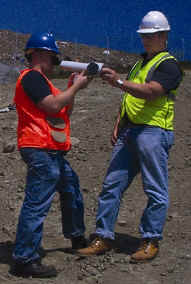
All
facilities will benefit from developing an odor response action
plan. It is important for every solid waste facility to have a
plan in place, regardless of whether it has experienced odor
complaints or a nuisance determination, because all landfills emit
some odor at times. If a facility waits until the new
guidelines require it to develop a plan, it runs the risk of
appearing recalcitrant, potentially squandering community goodwill
that may have taken decades to build. Furthermore, facilities
that wait until a crisis to develop an odor response plan may
undertake reactionary measures that may not represent the best
long-term odor minimization approach.
A
well-designed and executed odor response action plan, developed
before a time of crisis, acknowledges that all landfill facilities
have a baseline of odor. As long as the baseline does not exceed
nuisance levels, an odor problem will not arise. The most
successful odor response action plans independently detect increases
in on-site odor so that they can be corrected before off-site nuisances
ever arise. Tech Environmental has worked with many landfills in the
state of
Massachusetts
and across
New England
to develop odor response plans, both in times of crisis and as part
of a long-term odor management strategy.
EMPLOYEE
SPOTLIGHT
 Mr.
Michael T. Lannan is a chemical engineer who has provided odor
solutions for facilities all over the
United States
and the world. He has permitted and designed landfill gas odor
control systems for dozens of landfills, transfer stations, and
composting facilities all over the northeast. Mr.
Michael T. Lannan is a chemical engineer who has provided odor
solutions for facilities all over the
United States
and the world. He has permitted and designed landfill gas odor
control systems for dozens of landfills, transfer stations, and
composting facilities all over the northeast.
He first
began examining increases in the odor from solid waste facilities
using C&D fines for cover materials in the early 1990s.
Since that time he has develop a unique perspective on the
relationship between odor and health concerns at solid waste
facilities. He has helped reduce odor from solid waste facilities
working as a representative of the owner and surrounding neighbors.
He has provided input to solid waste regulations in a number of
states and municipalities.
Mr. Lannan
has written numerous odor response action plans and has provided
odor related training for solid waste facility personnel and
regulators. He recently completed an odor training course for
the Maine DEP residuals and solid waste departments. He will be
speaking during a seminar this November at a New
York SWANA meeting on odor control, and he is teaching a ½ day
course on landfill gas odor concerns at the annual SWANA
Landfill Gas Symposium in Houston,
TX
in April 2008. These odor control courses are certified for state
operator, professional engineering, and/or SWANA certification
continuing education credits.
As a
chemical engineer, Mr. Lannan has an excellent understanding of the
specific individual compounds in an odorous mixture, the ways in
which they react, the manner in which they can impact neighbors, and
the methods by which they can be removed. Mr. Lannan has examined,
designed, optimized, or replaced every commonly accepted odor
control technology on the market today. He is a registered
professional engineer in
Massachusetts, New Hampshire, Maine, Vermont and New York.
SUBSCRIBE
TO THIS NEWSLETTER
If you have been forwarded this email and wish to
receive it regularly, click here to subscribe.
|

