|
Tech
Environmental e-Newsletter
September
2007
THE
GROWTH AND POTENTIAL OF SMALL-SCALE WIND POWER
Wind power has been
around for centuries. Everyone has seen pictures of windmills in
Holland and in the American old West, used to pump water and grind
grain. In the late 1970s, wind power was utilized on a limited scale
to produce electricity. Wind turbines in that era were noisy,
expensive, and low-powered. Consequently, favorable locations for
wind turbine installations were limited.
However, recent
developments in wind turbine design have made small-scale
wind power generation much more practical. High-efficiency blade
designs, featuring stronger, lighter, larger blades, have led to
greatly improved power production, reduced costs, and low noise
levels. The new turbines are now practical and competitive for
wide-scale power generation usage. In particular, small-scale wind
projects are now being advanced by private developers who wish to
power their facilities with wind, as well as by communities who wish
to construct municipal wind power generating stations to reduce
citizens' electrical costs. The first type of project usually has
power levels below 2 MW, while the second usually has power levels up
to 10 MW.
 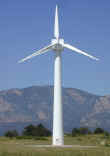
| Wind
turbine technology has advanced substantially from years past...
(1980s) |
|
...making
small installations more feasible. (2007) |
The demand for
these installations is evident across the Northeast: a columnist for
the Providence
Journal recently called for small-scale wind in Rhode Island,
while a selectman in Hampton,
New Hampshire is pushing for that municipality to utilize wind
power to its benefit. The Portland
Press Herald reported recently that several Maine towns are
following the lead of Saco, ME, which has installed one wind turbine
and is considering adding another. An Amherst, NH man made
headlines with his attempt to install wind turbines on his
property to power his house, while a recent
article reports that hundreds of small wind turbines are being
installed at homes in upstate New York. A lengthy
Boston Globe article described the movement toward small-scale
wind power as reaching "critical mass," describing efforts
to install wind turbines at such diverse facilities as a community
college, a high school, a union hall and a ski resort. At present, a
large number of other small-scale wind projects are being studied in
the Northeast.
Addressing
concerns about appearance, noise, shadow flicker, bird migration and
air traffic obstruction has proven to be a significant challenge for
potential project developers, both private and community-based. A
recent Salem
[MA] News editorial noted delays in a small-scale wind project on
Cape Ann due to legislative wrangling over the issue of wind turbines.
However, when relevant legislation is finalized and put in place
across the Northeast, small-scale wind projects will be able to move
forward with more certainty in the region. With luck and
regulatory/legislative cooperation, a sizeable fraction of these sites
will prove to be acceptable for wind power generation, and will soon
begin to provide clean, renewable power.
For
more information, contact Peter Guldberg at PGuldberg@techenv.com
or at ext. 106.
ONGOING
SMALL-SCALE
WIND PROJECTS
Many
of you have no doubt heard about some of the high-profile wind farms for which
Tech Environmental has provided noise and vibration services, including the Cape
Wind Project off the coast of Massachusetts. However, TE is presently assisting a number of developers and municipalities with
small-scale wind projects as well. Some of these projects are in
coordination with the Massachusetts Technology Collaborative (MTC),
the state's economic development agency for renewable energy and the
information economy. TE provides noise and vibration analysis to
determine the impacts from proposed wind turbines, and demonstrates
those impacts using computer models.
Ongoing
TE small-scale wind projects in Massachusetts include four turbines
for the town of Eastham, a pair of
turbines for the Town of Fairhaven, a single turbine
proposed on industrial land by a private developer in Gloucester,
and a single turbine proposed by a private developer at a private
high school in Worcester. We will continue to augment our work on
high-profile, large-scale efforts with small-scale projects like these, in the hopes
that the Northeast can continue to develop innovative energy sources
to match its ever-growing demand for power.
|
TECH
ENVIRONMENTAL WELCOMES
DR. HOWARD QUIN, INCE
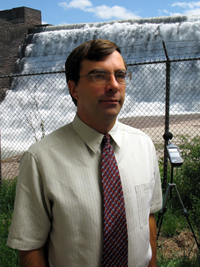
Tech
Environmental is pleased to welcome
Dr. Howard Quin, INCE to
our team as a Senior Scientist. Dr. Quin is a sound and
vibration consultant with over two decades of professional experience
in energy, industrial and transportation noise and vibration
studies.
Dr.
Quin has
performed noise measurement and acoustic modeling impact assessments
for transit, power plant, wind turbine, highway, airport, harbor,
construction and stationary source facilities in the Northeast,
Mid-Atlantic and Midwest
regions. He has worked on a variety of complex projects, including
several on-going wind turbine projects in New England; the construction of new tunnels and platforms at Grand Central and
Penn Stations in New York City; Boston mass transit projects like
the Urban Ring and Blue Line Extension; and a massive General Electric
remediation project to remove PCBs from the Hudson River.
Dr.
Quin has performed noise measurement and acoustic modeling impact
assessments for projects including the high-profile commercial South Station
Development and Bullfinch Triangle Redevelopment in Boston; impacts
from a municipal wastewater facility, the MWRA Union Park facility
in Boston; a harbor configured for offloading liquefied natural gas,
the Weaver’s Cove LNG Facility in Fall River, MA; and blast
monitoring projects at mines in Reading, PA and Hazleton, PA.
Dr. Quin also has extensive experience on
transportation projects, performing noise and vibration analysis,
computer modeling, and design recommendations on projects like the
Dulles Corridor Rapid Transit line in Washington D.C. Dr.
Quin is not only highly conversant with a number of contemporary
software programs, including Cadna/A, SoundPlan, TNM, WindPro, and
INM, but he understands the programming logic used as a basis for
each software package. As a result, he has developed customized
software on occasions when a project’s needs require it. Dr. Quin
wrote transit noise modeling software to model noise from commuter
trains, buses and transit lines using algorithms developed by the
FTA; this code was used on several transit noise projects, such as
the New Jersey Transit ARC and the MBTA
North
Shore
and Urban Ring Projects.
Dr.
Quin obtained a B.S. in Physics and a M.S. in Geophysics from
Stanford University, and a PhD. in Geophysics from Columbia
University.
You
can contact Dr. Quin at HQuin@techenv.com
or
at ext. 102.
We are conveniently located on Trapelo
Road at Reservoir Place on Route 128 at Exit 28 in Waltham,
Massachusetts.
Directions
CONTACT INFO
1601 Trapelo Road
Waltham, Massachusetts
02451
ph. 781-890-2220
fax 781-890-9451
VPMarketing@TechEnv.com
SUBSCRIBE TO THIS
NEWSLETTER
If
you have been forwarded this email and wish to receive it regularly,
then click here to
subscribe.
|
